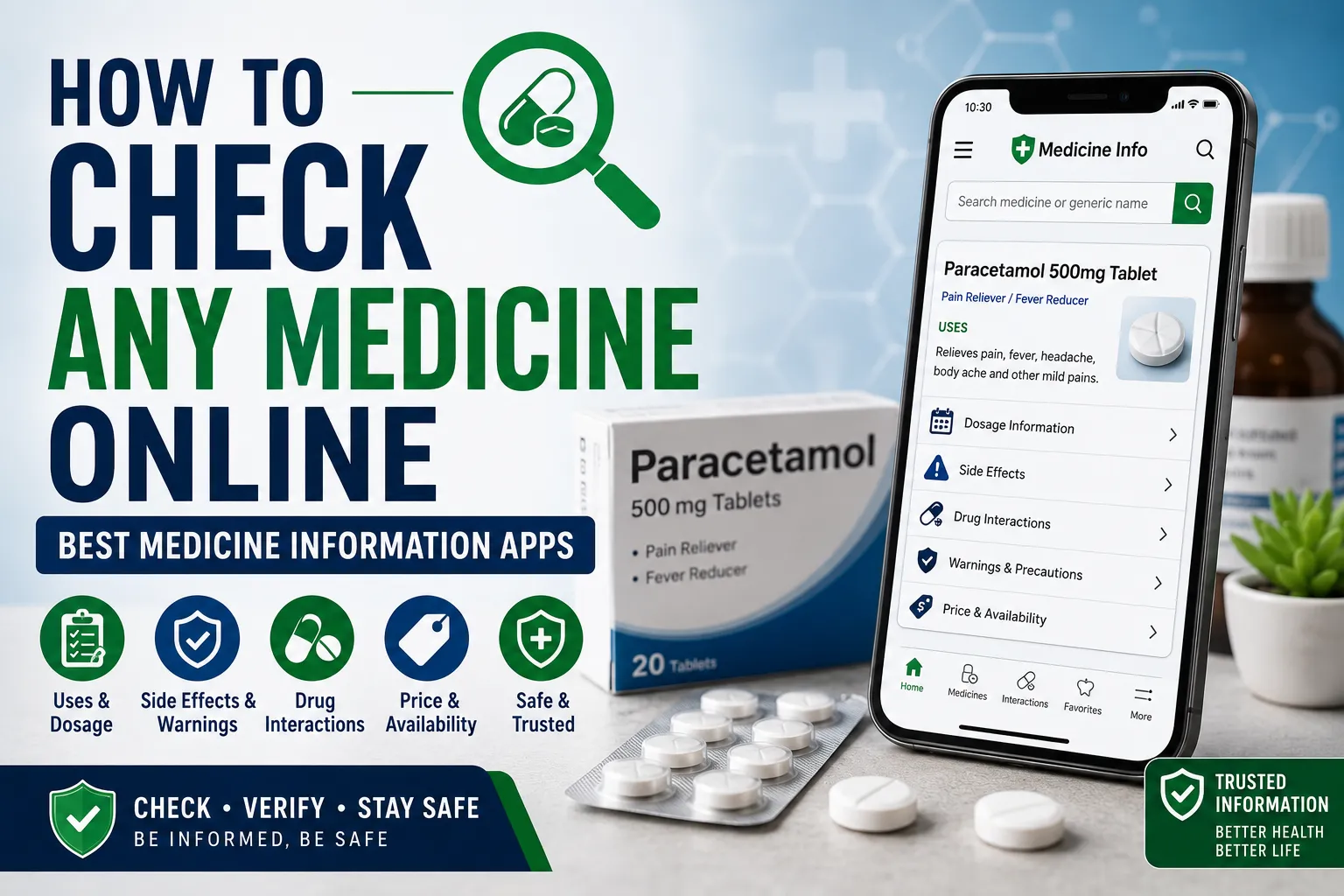
Have you ever found a medicine at home and wondered what it is used for, whether it is registered in Pakistan, what side effects it may cause, or whether it can be taken with another drug?
Several websites and mobile apps can help you check medicine information online. However, no app should be used as a replacement for a qualified doctor or pharmacist. Online tools are useful for understanding a prescription, confirming the active ingredient, checking common warnings and identifying possible drug interactions.
This guide explains how to check medicine information safely, which details to search for and which medicine-information apps and websites are most useful.
Medical disclaimer: This article is for general information only. Do not start, stop, replace or change the dose of a medicine based only on an app or website. Consult a doctor or registered pharmacist, particularly for children, pregnancy, older adults, chronic diseases and prescription medicines.
What Information Can You Check About a Medicine Online?
A reliable medicine database may provide:
- Generic or active ingredient
- Brand names
- Available strengths
- Dosage form
- Approved uses
- Common side effects
- Serious warnings
- Drug interactions
- Food and alcohol interactions
- Pregnancy and breastfeeding warnings
- Manufacturer information
- Registration status
- Maximum retail price
- Storage instructions
- Missed-dose guidance
Not every website provides all these details. For example, Pakistan’s Drug Regulatory Authority mainly helps users verify registration, product information and official pricing, while international drug references provide more detailed patient guidance and interaction information.
Information You Need Before Searching
Before searching for a medicine, read the box, bottle or blister pack carefully.
Write down the following details:
- Brand name: The commercial name printed prominently on the pack.
- Generic name: The active medicinal ingredient.
- Strength: For example, 5 mg, 500 mg or 125 mg/5 mL.
- Dosage form: Tablet, capsule, syrup, injection, cream or drops.
- Manufacturer: The company that produced or marketed it.
- Registration number: The number issued by the relevant regulatory authority.
- Batch number: Used to identify a particular manufacturing batch.
- Expiry date: The date after which the medicine should not be used.
- Tablet imprint: Letters or numbers printed directly on a tablet or capsule.
The generic name and strength are usually more useful than the brand name because the same medicine may be sold under many different brand names.
For example, searching only for a local brand may produce limited results on an international website. Searching its active ingredient can provide more complete information.
How to Check a Medicine Online in Pakistan
Step 1: Search the Medicine on the DRAP Database
The first step for a medicine being sold in Pakistan should be to check whether it appears in the official database of the Drug Regulatory Authority of Pakistan, commonly called DRAP.
DRAP maintains searchable databases for medicines approved for sale in Pakistan. Users can search by product name or registration number. The available records may include the brand name, dosage form, active ingredients, registration number, marketing-authorization holder and manufacturer.
To search effectively:
- Enter the exact brand name.
- Try the name without words such as tablet, capsule or syrup.
- Search using the registration number.
- Search the active ingredient when the brand is not found.
- Compare the manufacturer and strength with the physical pack.
A missing result does not automatically prove that a product is fake. The spelling may be different, the database may categorize it differently, or it may fall under another product category. However, an unverified product should not be used until a pharmacist or DRAP confirms its status.
Step 2: Check the Official Medicine Price
DRAP also provides a Pharmaceutical Product Price Index that allows users to search available pharmaceutical pricing information. This can help buyers compare the listed price with the price charged by a pharmacy.
Keep in mind that:
- Different pack sizes have different prices.
- Different strengths may have different prices.
- A tablet strip and a full box are not the same unit.
- Updated prices may take time to appear across pharmacies.
- Imported or shortage-affected products may require additional verification.
Check the exact strength, pack size and manufacturer rather than comparing only the brand name.
Step 3: Search the Generic Name on a Trusted Medical Website
After verifying the Pakistani product, search its generic ingredient on a recognized medical database.
For example, suppose the box contains:
Brand: Example Brand
Generic: Amoxicillin
Strength: 500 mg
Search for:
Amoxicillin 500 mg medicine information
Avoid vague searches such as:
What is this capsule?
A precise search usually produces more relevant and safer information.
Step 4: Read the Uses and Warnings
When opening a medicine page, review these sections first:
- What the medicine is used for
- Who should not take it
- Allergy warnings
- Common side effects
- Serious side effects
- Interaction warnings
- Pregnancy and breastfeeding information
- Storage instructions
Do not use the list of approved uses to diagnose yourself. A medicine may treat several conditions, but only a healthcare professional can determine whether it is appropriate for your symptoms.
Step 5: Check Drug Interactions
Drug-interaction checkers allow users to enter multiple medicines and see whether combinations may cause problems.
Include everything you take:
- Prescription medicines
- Over-the-counter medicines
- Vitamins
- Minerals
- Herbal products
- Traditional remedies
- Protein or fitness supplements
Herbal and complementary products can also interact with prescription medicines, so they should be included in medication reviews rather than treated as automatically safe.
An interaction warning does not always mean two medicines can never be used together. Some combinations require a lower dose, different timing, laboratory monitoring or medical supervision. Never stop a prescribed drug without consulting the prescriber.
Best Medicine Information Apps and Websites
1. Drugs.com Medication Guide
Best for: General medicine information, pill identification and interaction checking
The Drugs.com app provides:
- Drug and treatment information
- Interaction checking
- Pill identification
- Medication lists
- Reminders and alerts
- Some offline access
Its pill identifier allows users to search by a tablet’s imprint, color and shape. However, its pill-image database is largely focused on medicines marketed in the United States, so it may not identify many Pakistani brands or locally manufactured tablets.
Advantages
- Easy for patients to understand
- Useful interaction checker
- Medication reminders
- Good pill-identification tools
Limitations
- Local Pakistani brands may not be listed.
- Pill appearance alone cannot confirm authenticity.
- Information should not replace professional advice.
2. Medscape
Best for: Detailed drug information and healthcare professionals
Medscape provides a medicine reference, drug-interaction checker, pill identifier, medical calculators and clinical educational material. Its interaction checker can compare prescription medicines, supplements and certain food-related interactions.
Advantages
- Detailed clinical information
- Drug-interaction checker
- Useful for doctors, pharmacists and medical students
- Includes medical news and professional resources
Limitations
- Some terminology may be difficult for general readers.
- Certain features may require an account.
- Drug names and regulatory information may be US-focused.
3. Epocrates
Best for: Doctors, pharmacists and advanced medicine searches
Epocrates is designed primarily as a clinical drug-reference app. It provides drug monographs, interaction checking, dosing tools, pill identification and other clinical resources. Its current interaction tool can compare multiple prescription medicines, over-the-counter products and supplements.
Advantages
- Fast professional drug reference
- Detailed interaction information
- Useful dosing and clinical tools
- Suitable for healthcare professionals
Limitations
- Some advanced features require payment.
- Clinical language may be difficult for patients.
- It should not be used to calculate your own dose.
4. WebMD App
Best for: Beginner-friendly medicine and general health information
The WebMD app is available for Android and iOS and provides medicine information, side effects, warnings, a pill identifier, health articles and medication reminders.
Advantages
- Simple interface
- Patient-friendly explanations
- Pill-identification tool
- Medicine reminders
- General health information
Limitations
- Some features and pharmacy information are region-specific.
- Symptom checkers cannot provide a confirmed diagnosis.
- Local medicine brands may not appear.
5. MedlinePlus
Best for: Reliable and easy-to-understand patient information
MedlinePlus is operated by the United States National Library of Medicine, part of the National Institutes of Health. It provides patient-focused information about prescription drugs, over-the-counter medicines, herbs and supplements.
Medicine pages may explain:
- Why a medicine is prescribed
- How it is commonly taken
- Important precautions
- Side effects
- Storage
- Missed doses
- Emergency warnings
Advantages
- Government-supported health resource
- Free to use
- Clear patient language
- Covers medicines, herbs and supplements
Limitations
- It is mainly a website rather than a full medicine-management app.
- Pakistani brand names may not appear.
- Exact prescribing instructions can differ by country and patient.
6. DailyMed
Best for: Official and detailed medicine labels
DailyMed is maintained by the US National Library of Medicine and provides current labeling submitted for prescription and nonprescription medicines. Its records may include ingredients, indications, dosage information, warnings, contraindications and packaging details.
Advantages
- Detailed official labeling
- Useful for checking active ingredients
- Includes prescription and nonprescription products
- Helpful for advanced research
Limitations
- Technical language
- Mainly covers US-market labels
- Not designed as a personal treatment guide
7. NHS Medicines A to Z
Best for: Clear instructions and common patient questions
The UK National Health Service’s Medicines A to Z explains how common medicines work, how they are generally taken, possible side effects and answers to frequently asked questions.
Advantages
- Easy-to-read language
- Clear side-effect information
- Practical patient guidance
- Reliable public-health source
Limitations
- Not every medicine is listed.
- Guidance follows UK medical practice.
- Local brand names and Pakistani regulatory details are not included.
8. DRAP Registered Drugs and Pricing Databases
Best for: Verifying medicines sold in Pakistan
For Pakistani users, DRAP should be the primary source for checking:
- Whether a product is registered
- Product registration information
- Active ingredients
- Manufacturer or authorization holder
- Listed medicine price
- Product recalls and safety alerts
DRAP also publishes alerts concerning falsified, spurious, unregistered or recalled products. These alerts may identify affected brands, manufacturers or batches and advise the public to obtain medicines from authorized sources.
Advantages
- Official Pakistani regulator
- Best source for local registration
- Official price-search facility
- Publishes recalls and safety alerts
Limitations
- It is not a complete patient-education app.
- Search results may require exact spelling.
- It may not provide detailed interaction explanations.
Quick Comparison of Medicine Apps
| App or website | Best use | Pill identifier | Interaction checker | Pakistan registration |
|---|---|---|---|---|
| DRAP | Registration, pricing and recalls | No | No | Yes |
| Drugs.com | General medicine information | Yes | Yes | No |
| Medscape | Detailed clinical reference | Yes | Yes | No |
| Epocrates | Professional drug information | Yes | Yes | No |
| WebMD | Beginner-friendly guidance | Yes | Yes | No |
| MedlinePlus | Patient medicine education | No | Limited medicine warnings | No |
| DailyMed | Official detailed labels | Label images may be available | Label-based information | No |
| NHS Medicines A to Z | Simple patient guidance | No | No dedicated checker | No |
How to Identify an Unknown Tablet or Capsule
An unknown tablet should never be taken based only on a visual match.
To investigate it:
- Note every letter and number printed on it.
- Check both sides.
- Record its color.
- Record whether it is round, oval, capsule-shaped or another shape.
- Check whether it has a dividing line.
- Use a recognized pill identifier.
- Compare the result with the original packaging.
- Ask a pharmacist to confirm it.
Pill-identification databases commonly use the imprint, color and shape to narrow possible matches. The imprint is usually more useful than the tablet color alone.
Why a Photograph Is Not Enough
Two tablets can look similar while containing different active ingredients or strengths. Counterfeit tablets may also imitate the appearance and packaging of a legitimate product.
An image-search result cannot verify:
- The chemical contents
- Correct strength
- Manufacturer authenticity
- Storage conditions
- Batch quality
- Whether the tablet has been contaminated
- Whether it is safe for you
When a tablet cannot be positively identified, do not consume it. Take it, along with its packaging, to a registered pharmacist.
How to Check Whether a Medicine Is Fake
Online checking can reduce risk, but it cannot always prove authenticity.
Look for the following:
Registration Information
Compare the product with the DRAP registered-drug record. Check the product name, active ingredients, strength and manufacturer.
Packaging Quality
Examine the pack for:
- Spelling mistakes
- Poor printing
- Broken seals
- Altered labels
- Missing batch number
- Missing registration details
- Unclear expiry date
- Different information on the box and blister
- Unusual color, smell or tablet shape
Batch and Expiry Details
The batch number and expiry date on the outer box should match the blister, bottle or internal packaging where applicable.
Pharmacy Source
Purchase medicines from a licensed and reputable pharmacy. DRAP advises the public to avoid suspicious or unauthorized products and obtain medicines through authorized sources.
Recall and Safety Alerts
Search DRAP’s recall and rapid-alert section using:
- Brand name
- Generic name
- Manufacturer
- Batch number
Falsified medicines may contain incorrect ingredients, no active ingredient, an incorrect dose or potentially harmful substances. DRAP has warned that falsified products can lead to treatment failure, worsening disease and potentially serious harm.
What to Do When Different Websites Give Different Information
Medicine information may differ because:
- Different countries have different approved uses.
- Brand formulations may not be identical.
- Available strengths can vary.
- Regulators may issue different warnings.
- One source may have been updated more recently.
- Patient instructions may be simplified while professional labels are detailed.
Use this priority order:
- Your doctor’s written prescription
- Instructions from a registered pharmacist
- The leaflet supplied with the medicine
- Pakistan-specific DRAP information
- Official international drug labels
- Trusted medical-information websites
- General websites, forums and social-media posts
Do not use an anonymous social-media comment as the main source for a medication decision.
Red-Flag Symptoms Requiring Urgent Medical Help
Seek urgent medical assistance after taking a medicine if you develop:
- Difficulty breathing
- Swelling of the face, lips, tongue or throat
- Fainting or severe dizziness
- Chest pain
- Severe confusion
- Seizure
- Blue lips
- Severe or spreading skin rash
- Uncontrolled bleeding
- Vomiting blood
- Black stools
- Sudden weakness on one side
- Suspected overdose
- Accidental medicine ingestion by a child
Do not wait for an app to identify the problem during a medical emergency. Take the medicine pack or a photograph of it to the hospital when possible.
Important Medicine-Safety Rules
Never Copy Another Person’s Prescription
Two people with similar symptoms may need completely different treatments because of age, allergies, pregnancy, kidney function, liver function or other medicines.
Do Not Change the Dose Yourself
A higher dose can cause poisoning, while a lower dose can make treatment ineffective.
Do Not Stop Long-Term Medicines Suddenly
Some medicines for blood pressure, epilepsy, anxiety, depression, steroids and other conditions may cause serious problems if stopped abruptly.
Check the Active Ingredient
Two different brands may contain the same active ingredient. Taking both can accidentally double the dose.
Include Supplements in Interaction Checks
Vitamins, herbal remedies and traditional products may interact with prescription medicines.
Keep an Updated Medicine List
Write down:
- Medicine name
- Strength
- Dose
- Timing
- Reason for taking it
- Prescriber
- Allergies
- Supplements
Medication-safety guidance encourages patients to know their medicines, check the dose and timing, maintain an updated medicine list and ask a pharmacist or healthcare professional when uncertain.
Frequently Asked Questions
Can I check a medicine by its brand name?
Yes. Start with the exact brand name, but also search the generic ingredient because international databases may not recognize Pakistani brands.
How can I check whether a medicine is registered in Pakistan?
Search for the product name or registration number in the official DRAP registered-drug database. Compare the active ingredient, dosage form and manufacturer with the physical pack.
Which app is best for checking drug interactions?
Drugs.com is easy for general users, while Medscape and Epocrates provide more detailed clinical information. An interaction result should still be reviewed by a doctor or pharmacist.
Which website is best for medicine information in Pakistan?
Use DRAP for registration, pricing and recall information. Use MedlinePlus, NHS Medicines A to Z, DailyMed or another reputable drug reference for patient guidance and detailed medicine information.
Can an app identify a tablet from a photograph?
Some tools can suggest possible matches using an imprint, color and shape. A visual match is not proof of identity, strength or authenticity, particularly for locally manufactured or counterfeit medicines.
Can I check medicine prices online in Pakistan?
Yes. DRAP provides an online Pharmaceutical Product Price Index. Make sure you compare the exact strength, dosage form, pack size and manufacturer.
Is it safe to take a medicine after reading about it online?
No medicine should be started merely because its listed uses appear to match your symptoms. Diagnosis, dose, duration, allergies and interactions must be considered by a qualified professional.
What should I do when a medicine is not found online?
Check the spelling, search its generic ingredient, try the registration number and ask a pharmacist. Do not use an unverified medicine until its identity and source are confirmed.
Can online tools tell me the correct dose?
They may display standard or approved doses, but your correct dose may depend on age, weight, diagnosis, pregnancy, kidney or liver function and other medicines. Use only the dose prescribed by your healthcare professional.
Final Words
Medicine-information websites and apps can help you become better informed about the products you take. They can explain active ingredients, common uses, side effects, warnings and possible interactions.
For medicines sold in Pakistan, begin with the official DRAP databases to verify registration, price and safety alerts. You can then search the generic ingredient on trusted resources such as MedlinePlus, DailyMed, NHS Medicines A to Z, Drugs.com, Medscape, Epocrates or WebMD.
Most importantly, never take an unidentified tablet, purchase prescription medicines from an unverified source or change treatment based only on an online search. Use digital medicine tools to support—not replace—the advice of a qualified doctor or pharmacist.