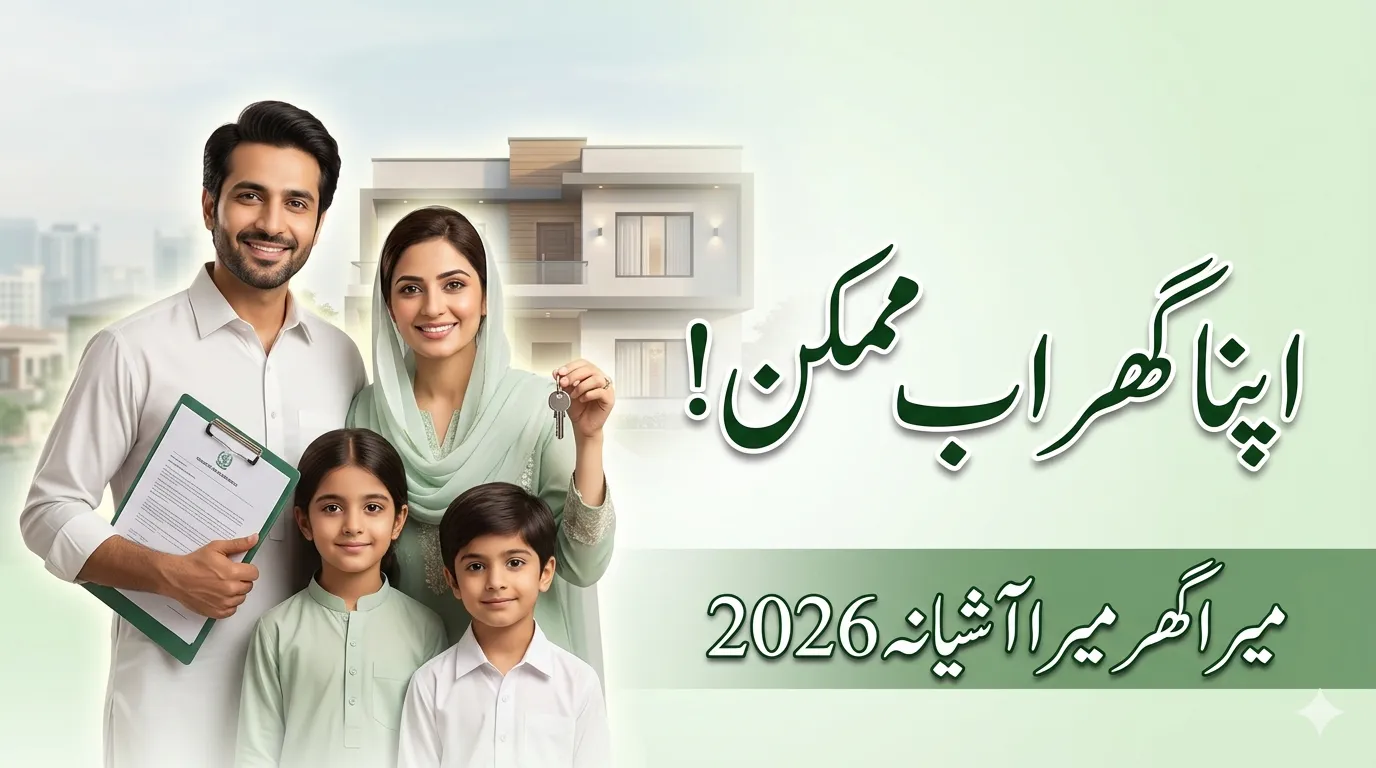
Mera Ghar Mera Ashiana Owning a home in Pakistan has long been seen as a luxury rather than a basic necessity. With soaring property prices and limited financing options, many families have spent years stuck in rented homes. That’s where the Mera Ghar Mera Ashiana Scheme 2026 steps in as a game-changer. This government-backed housing initiative is specifically designed to make homeownership accessible for low- and middle-income families across Pakistan.
At its core, the scheme offers subsidized home loans through banks, allowing individuals to either build, buy, or renovate a house. What makes it particularly attractive is the involvement of the Government of Pakistan and the State Bank of Pakistan (SBP), which ensures reduced markup rates and a structured repayment system.
Unlike traditional housing loans that often come with high interest rates and strict eligibility criteria, this scheme lowers financial barriers. With markup rates as low as 5% to 8% and repayment periods extending up to 20 years, it provides a realistic pathway for families who previously couldn’t even dream of owning a home.
Think of it this way: instead of paying rent month after month with nothing to show for it, you’re gradually investing in something that becomes your permanent asset. That shift—from tenant to homeowner—is exactly what this scheme aims to achieve.
Read Also: Italy Work Visa 2026 164,000+ Jobs Open for Pakistanis Apply Before Quota Fills
Why Homeownership is Difficult in Pakistan
Rising Property Prices and Inflation
Let’s be honest—if you’ve ever browsed property listings in Pakistan, you’ve probably felt that sinking feeling. Prices keep climbing, and salaries rarely keep up. Over the past few years, inflation has significantly impacted construction costs, land prices, and even basic housing materials. For an average salaried individual, saving enough for a house can take decades.
Urban areas like Lahore, Karachi, and Islamabad have become especially expensive. Even a modest 5-marla house can cost millions, pushing homeownership further out of reach. The dream of owning a home starts to feel like chasing a moving target—every time you get closer, prices jump again.
Challenges in Traditional Bank Loans
Now, you might think, “Why not just take a bank loan?” That’s where things get tricky. Traditional housing loans in Pakistan often come with high interest rates, complex documentation, and strict income requirements. Banks are cautious lenders, and without strong financial records, many applications are rejected outright.
Even if approved, the monthly installments can be overwhelming. Imagine paying a high EMI on top of your daily expenses—it’s simply not sustainable for most families. This gap between affordability and accessibility is exactly what the Mera Ghar Mera Ashiana Scheme 2026 is trying to bridge.
Read Also: Search by Image ID Safe Check App The Complete Guide to Online Security
Key Features of the Scheme
Low Markup Rates and Subsidies
One of the biggest attractions of this scheme is its subsidized markup rates, significantly lower than market rates. Instead of dealing with unpredictable interest rates, borrowers benefit from fixed rates—starting at around 5% for smaller loans and up to 8% for larger ones.
The government covers a portion of the markup, reducing the financial burden on borrowers. This means your monthly payments remain stable and manageable, even if the market fluctuates.
Flexible Loan Tenure
Another major advantage is the long repayment period. With tenures of up to 20 years, borrowers can spread their payments over a longer time, reducing monthly pressure.
It’s like stretching a heavy load across a longer distance—it becomes easier to carry. This flexibility is crucial for families with limited monthly income.
Minimum Down Payment Requirements
Unlike traditional loans that require large upfront payments, this scheme allows a down payment of just 10%.
For many families, this is the difference between “impossible” and “achievable.” Saving 10% is challenging, but far more realistic than arranging 30% or 40% upfront.
Read Also: Upload an Image to a Reverse Image Search Tool
Loan Structure and Financing Tiers
Tier 1 Loan Details
Tier 1 is designed for lower-income applicants. It offers loans up to PKR 2 million with a fixed markup of 5%.
This tier is ideal for small houses or basic construction projects. It ensures that even families with modest incomes can access financing.
Tier 2 Loan Details
Tier 2 caters to slightly higher income groups, offering loans between PKR 2 million and PKR 3.5 million at around 8% markup.
Here’s a quick comparison:
| Loan Tier | Loan Amount | Markup Rate | Target Group |
|---|---|---|---|
| Tier 1 | Up to PKR 2M | 5% | Low-income families |
| Tier 2 | PKR 2M–3.5M | 8% | Middle-income families |
This tiered structure ensures fairness, allowing different income groups to benefit accordingly.
Eligibility Criteria Explained
Basic Requirements
To apply, you must meet a few basic conditions:
- Pakistani citizen with valid CNIC
- First-time homebuyer (no existing property)
- Proof of stable income
- Clean or acceptable credit history
The scheme is specifically designed for first-time homeowners, ensuring that the benefits go to those who truly need them.
Read Also: How to Use Briar App (Step-by-Step) | Private Messaging Without Internet
Income and Credit Requirements
Both salaried and self-employed individuals can apply. Banks will evaluate your income to determine your repayment capacity. If you run a small business, don’t worry—you’re still eligible as long as you can prove your income.
Your credit history also plays a role. While minor issues may not disqualify you, maintaining a clean banking record significantly improves your chances of approval.
Property Requirements Under the Scheme
Not every property qualifies under this scheme. The government has set guidelines to ensure affordability and fairness. Typically, properties include:
- Houses up to 5 marla size
- Apartments around 1,360 sq ft
- Legally approved housing units
This focus on smaller properties ensures that the scheme remains accessible to the target audience.
Step-by-Step Application Process
Choosing a Bank
Start by selecting a participating bank such as HBL, UBL, Meezan Bank, or NBP. These banks have dedicated housing finance desks to assist applicants.
Document Preparation
Prepare essential documents, including:
- CNIC copy
- Income proof
- Bank statements (last 6 months)
- Property documents
Loan Approval Process
Once you submit your application:
- The bank evaluates your financial profile
- Documents are verified
- Property is inspected
- Loan is approved and disbursed
The process is streamlined, with some banks offering approvals within 10–15 days.
Monthly Installments (EMI) Breakdown
Let’s make it real with an example:
- Loan: PKR 3,000,000
- Tenure: 20 years
- Markup: ~6%
Estimated EMI: PKR 20,000–25,000/month
This is often comparable—or even cheaper—than renting in major cities.
Benefits of the Scheme
The advantages are hard to ignore:
- Lower interest rates than conventional loans
- Affordable monthly installments
- Government-backed security
- Opportunity for first-time buyers
- Nationwide availability
It transforms the idea of homeownership from a distant dream into a practical goal.
Read Also: 10 Mobile Security Mistakes That Could Put Your Data at Risk (Fix Them Now)
Common Mistakes to Avoid
Many applicants face rejection due to simple mistakes:
- Incomplete documents
- Overestimating income
- Poor credit history
- Choosing unapproved property
Avoid these pitfalls to increase your chances of approval.
Practical Tips for Loan Approval
Want to improve your chances?
- Save at least 10–20% down payment
- Maintain a clean bank record
- Avoid taking new loans before applying
- Consult bank officers for updated rules
Preparation makes all the difference.
Real-Life Impact and Success Potential
Imagine a school teacher who has spent years paying rent. With this scheme, that same monthly payment now goes toward owning a home. Or a small shop owner who finally builds a house on inherited land. These aren’t just hypothetical stories—they’re becoming reality for thousands of families.
The scheme also boosts the economy by creating jobs in construction, materials, and real estate sectors. It’s not just about houses—it’s about building futures.
Conclusion
The Mera Ghar Mera Ashiana Scheme 2026 is more than just a housing program—it’s a lifeline for families striving for stability and security. With low markup rates, flexible repayment options, and strong government backing, it breaks down barriers that once made homeownership impossible.
If you plan carefully, manage your finances wisely, and follow the application process, this scheme can truly transform your life. Your dream home might be closer than you think.
Read Also: Meezan Bank Bike Installment Plan 2026 Easy Halal Way to Own a Bike in Pakistan
FAQs
1. Who is eligible for the scheme?
Pakistani citizens with valid CNIC, stable income, and no prior property ownership can apply.
2. What is the minimum down payment?
Typically around 10% of the property value.
3. Can self-employed individuals apply?
Yes, as long as they can provide proof of income.
4. How long is the loan tenure?
Up to 20 years, depending on the bank and loan type.
5. Which banks offer this scheme?
Major banks like HBL, UBL, Meezan Bank, and NBP participate.